Jim Champy, author of many management bestsellers, including Reengineering the Corporation, led a fascinating discussion 18 April 2006 at Chicago’s Standard Club, sponsored by Perot Systems. Beginning with the presentation, “Doing Business in a Flat World: An Exploration of the Next Era in Globalization,” Jim gave attendees an invaluable perspective on how executives needed to reengineer reengineering for the knowledge economy. He highlighted past transformational efforts in the industrial economy (the original reengineering) and focused on how to achieve change in the knowledge economy. As usual, I will summarize key points of the discussion first and follow up with my insights.
Reengineering: 20th Century
In the 80s and 90s, reengineering helped businesses improve their business processes. For example, an insurance company regularly required 24 days to issue a policy because 13 departments were involved, each of which had optimized processes for itself, not the enterprise (or the customer). In fact, to issue the policy took ten minutes of actual work; the rest was administrative time. Today, business models of the industrial era are becoming obsolete, but most companies haven’t yet changed how they manage their businesses. A default method of drastic organization change, often employed by IBM and many others, […]
The emerging knowledge economy will reconfigure the role of discovery in innovation in some surprising ways. First, a couple corollaries:
For most of the history of mankind, information has been scarce, and an important way that people innovated was through discovery. In agrarian and industrial economies, it was extremely important to discover new ways to transform raw materials in order to create new products. Since people lived in relative isolation compared to today, there was significant duplication of discovery efforts in pockets around the world. The pervasive TCP/IP network (i.e. Internet), combined with accelerating adoption of modern architectural approaches (i.e. service-oriented architecture) and messaging (Web services and XML) is unlocking the world’s data/information as a dizzying pace. It’s a cliché that we have too much information, and this trend shows no sign of abating. Moreover, software tools for automating the management of information are improving all the time. Of course, this development gives people an unprecedented ability to collaborate—on everything.
In the knowledge economy, discovery gets leveraged, pervasively and instantaneously. Discovery will remain extremely important to creating value, but I’m going to argue that it will play a cameo role in the hyper-innovation knowledge economy: crucial but supporting.
Anyone attending […]
China Analysis and Outlook 2006 reveals an emerging opportunity to rebalance economic and political influence.
 Part II of the 2006 Economic Forecast featuring David Hale (presented Part I) and Lyric Hughes-Hale. Here, I present my notes of Lyric’s talk, followed by my observations. Part II of the 2006 Economic Forecast featuring David Hale (presented Part I) and Lyric Hughes-Hale. Here, I present my notes of Lyric’s talk, followed by my observations.
Background: China’s development and situation are far more complex than U.S. news sources report. It has seen significant economic liberalization during the past 25 years, and it shows every sign of continuing on that trajectory. However, the country is politically conservative. There is no freedom of the press. That said, the authoritarian government may produce reform much more quickly than if China had been democratic because the democratic process often slows reform. China is far more open and engaged on the world stage than it has been in many years. […]

SMA 21st Annual Economic Forecast 2006 is my coverage of the SMA/Harvard Club annual confab featuring David Hale and Lyric Hughes-Hale
The Strategic Management Association and The Harvard Club jointly sponsored the Economic Forecast 2006 featuring David Hale and Lyric Hughes-Hale. David presented his encyclopedic knowledge and perspective on global economic trends, while Lyric shared her insights on China in Part II of the evening (she was the founder of China Online and has focused on China for several years.).
As usual, I present my notes, followed by my insights. Here are my notes from David’s presentation (Part I of the meeting).
[…]
Adam Hartung of Spark Partners led a compelling and thought-provoking discussion at this month’s MITEF meeting on 14 March in Chicago. Adam is a veteran of a bevy of management consultancies and large corporations who has spent the last four years researching a hypothesis about innovation, writing a book (The Phoenix Principle) and consulting. His observations are straightforward, profound and potentially healing for industrial economy companies.
Summary of the Meeting and Discussion “Lock-in” is a corporate phenomenon that is fatal for organizations because it prevents new thinking. New thinking is increasingly important because the market is more volatile than ever. Lock-in happens in a cycle: in its formative stage, the corporation experiences success, and success “hardens” into a success formula; it leaves an imprint on executives, workers and customers, who all identify with the success. Of course, the problem arises when the market moves and nullifies some key assumptions that are embedded in the success formula. There are three types of lock-in:
Behavioral lock-in: group-think, not invented here; slow decision making; rigid ideas about customers and products; sacred cows. Profits from financial manipulation. Structural lock-in: many, but one stood out–“biased toward easily quantified, traditional actions and against more speculative […]
Surprises in the Emerging Chinese Consumer Market highlights the Internet-powered practice of consumer collaboration and group buying for discounts.
“Chinese Consumers Overwhelm Retailers with Team Tactics,” The Wall Street Journal, February 28, 2006 is a perfect example of how mature market assumptions can lead to surprises in emerging markets. Chinese consumers increasingly meet on the Internet chat rooms to plan and coordinate a group buying strategy for a type of good or even brand. Then they go to the retailer as a group to extract significant group discounts. This practice is known as tuangou, or team purchase, and can play havoc with companies’ pricing strategies and margins, to say the least.
[…]
The American Marketing Association Chicago Chapter held its Power Lunch round tables, 23 February 2006 in Chicago. I hosted Technology and Strategy tables, where marketing leaders from Fortune 1000 companies, startups and service providers exchanged impressions about emerging marketing trends and techniques. Here are my notes from the discussion.
[…]
Insight about Human Resources in China featured speakers with decades of experience on the ground in China and offered surprising experiences. The GSB (Booth) International Round Table hosted two Asia and cross-cultural experts 16 February 2006 at Gleacher Center, “Human Resource Challenges for Multinational Corporations in China.” As is my custom, I will summarize the salient facts of the session first, which will be followed by my analysis.
This discussion was led by Deborah Lauer, former VP Global Talent Supply at Motorola who spent six years in China, and Jeffrey Reed, a 20 year veteran of Asia who headed up Unilever-Best Foods joint ventures in Pakistan and China. The talk focused on MNCs’ (multinational corporations) human resource challenges in China, both from expatriate and local talent perspectives. Many of the ideas presented corresponded to the ITA Round Table led by Dr. Wolfgang Fürniß (see China: The New Economy).
[…]
In the post-Internet-boom period, it’s easy to forget about some old friends, so here I thought I’d drop in and revisit e-commerce…
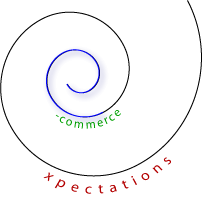 The old joke about commitment being like a ham and eggs breakfast certainly applies to producers (of goods) and consumers in the industrial economy. The punch line is that the chicken (consumer) is involved, but the pig (producer) is committed. The old joke about commitment being like a ham and eggs breakfast certainly applies to producers (of goods) and consumers in the industrial economy. The punch line is that the chicken (consumer) is involved, but the pig (producer) is committed.
A large part of producers’ inflexibility today is due to the fact that they are committed to bits (as opposed to bytes) at all stages of production and distribution: inputs, inventory, safety stocks, unsold goods, returns “… the whole catastrophe,” as Zorba says. These commitments are, in many cases, more important to producers than putting the customer first, and they represent a critical barrier to industrial economy companies’ intimacy with consumers because companies must sacrifice customer needs to maintain their operating realities. (For more on this, see Transformation: from Self-contained Company to Networked Global Organization.)
E-Commerce is steadily liberating producers from this dilemma in many categories. Let’s take a banal example. Probably most readers have shopped at “Earth’s Biggest Bookstore.” For many people, it defined the e-commerce […]
A blog is not like a plant of the desert variety; it needs watering more often, so here’s an excerpt from my imminent Market Advisory on the marketing tectonic shift:
The Mirror: Customer Experience and Intimacy
We will see more changes in marketing practices from 2006-2015 than in the rest of the profession’s history because marketing will be the vanguard for the shift from an industrial economy to a knowledge economy, which will demand competence in all encompassing customer experience in order to achieve differentiation. Similarly, the globalization of markets is accelerating: emerging markets will represent extraordinary potential, but addressing them will demand unprecedented innovation. In a bright spot, ongoing CRM and BI initiatives, combined with continuing standardization of architecture (SOA) and messaging (Web services, XML), will begin to deliver the proverbial 360° view of the customer.
The Customer Experience Imperative
The customer experience will be mandated from producer and consumer quarters. Consumers have product fatigue. In many categories, there are too many choices with little differentiation save price. Producers will have unprecedented information, which they will explicitly use to create experiences. In fact, no consumer wants a product or service anyway; rather, consumers buy products and services in order […]
|
|
