Visions for Technology Leadership
 After Gary Forsee’s luncheon address, a diverse panel of executives took the stage to discuss global technology leadership. Hardik Bhatt, CIO of the City of Chicago, Steve Goldman, Director of Architecture, the Chicago Mercantile Exchange, Raymond Spencer, CEO of Kanbay International, and David Weick, Global CIO of McDonald’s, shared their visions for Chicago’s global role in the world. Janet Kennedy, Midwest General Manager of Microsoft, gracefully moderated the panel discussion. The Executives’ Club of Chicago’s quarterly Technology Conference took place March 8 at the Chicago Hilton. After Gary Forsee’s luncheon address, a diverse panel of executives took the stage to discuss global technology leadership. Hardik Bhatt, CIO of the City of Chicago, Steve Goldman, Director of Architecture, the Chicago Mercantile Exchange, Raymond Spencer, CEO of Kanbay International, and David Weick, Global CIO of McDonald’s, shared their visions for Chicago’s global role in the world. Janet Kennedy, Midwest General Manager of Microsoft, gracefully moderated the panel discussion. The Executives’ Club of Chicago’s quarterly Technology Conference took place March 8 at the Chicago Hilton.
“Getting global” can mean many things, and panelists hit the issue from many directions. I’ll venture that, more than anything, it means changing one’s mindset, focus and approach, all of which are difficult to measure. All panelists represented organizations that had had international operations for decades, so how is global different?
[…]
Sprint Nextel’s Destiny and the Demand for a New Wireless Future reports on how Sprint Nextel is betting its future on a new wired society.
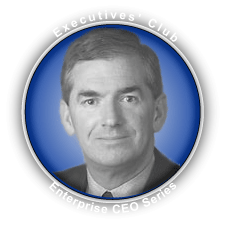 Gary D. Forsee, Chairman and CEO, Sprint Nextel Corporation, set the stage for the Executives’ Club of Chicago’s Technology Conference by outlining Sprint’s wireless strategy and a new vision for global community at the March enterprise CEO luncheon at the Chicago Hilton. Gary D. Forsee, Chairman and CEO, Sprint Nextel Corporation, set the stage for the Executives’ Club of Chicago’s Technology Conference by outlining Sprint’s wireless strategy and a new vision for global community at the March enterprise CEO luncheon at the Chicago Hilton.
Sprint’s long history reflects the transformation of the U.S. telecoms market. The company has had a key role in remaking the U.S. telecoms industry during its privatization. It competed as a competitive local exchange carrier (CLEC) and once earned most of its revenue from long distance services, which are now essentially free. After its 2005 merger with Nextel, virtually all its revenue comes from wireless services.
Moreover, Mr. Forsee promised that Chicago would be one of two pilot cities for Sprint’s WiMAX initiative later this year. Chicagoans will be among the first in the U.S. to try 4G network services.
Sprint’s Wireless Future
Sprint Nextel has seen the future, and it […]
Helps Busy Executives to Tap Growing Online Professional Network
 March 18, 2007, Chicago, USA—Today, The Global Human Capital Journal released its Review and The Unofficial LinkedIn User”s Guide to aid executives and professionals to mine the hidden value of the rapidly growing website. Founded in 2003, LinkedIn is a leading “social” network site for managing business relationships. It currently has over nine million global members who collaborate for professional purposes. March 18, 2007, Chicago, USA—Today, The Global Human Capital Journal released its Review and The Unofficial LinkedIn User”s Guide to aid executives and professionals to mine the hidden value of the rapidly growing website. Founded in 2003, LinkedIn is a leading “social” network site for managing business relationships. It currently has over nine million global members who collaborate for professional purposes.
LinkedIn represents a transformation opportunity for the Global Human Capital Journal”s executive readership. Business and government leaders can significantly increase their ability to execute strategy by leveraging emerging peer to peer knowledge networks. Notably, an executive”s LinkedIn network is beholden to no employer and can increase mobility.
However, online social networks represent a new social milieu. Most executives interviewed by the GHCJ showed a clear mental gap in understanding the potential of online professional networks. Interviewees included LinkedIn members and nonmembers.
GHCJ Chief Editor Christopher Rollyson, a known networker in high tech and corporate circles, explained the motivation for the project:
“I saw a disconnect between LinkedIn and some of the people who would benefit most by using it—corporate executives […]
How to Increase Your Payback from Using LinkedIn
 LinkedIn is a “social” site that will prove to be of rare benefit to business executives and professionals in building individualized collaborative networks, as I explained in detail in the GHCJ Review of LinkedIn. However, LinkedIn is seriously lacking in providing a step-by-step guide to help the motivated executive to tap its real value. The functionality of the website is easy to use, but many of the finer points of LinkedIn are lost on the majority of users. This guide attempts to address that. LinkedIn is a “social” site that will prove to be of rare benefit to business executives and professionals in building individualized collaborative networks, as I explained in detail in the GHCJ Review of LinkedIn. However, LinkedIn is seriously lacking in providing a step-by-step guide to help the motivated executive to tap its real value. The functionality of the website is easy to use, but many of the finer points of LinkedIn are lost on the majority of users. This guide attempts to address that.
[…]
Valuable Space to Create Your Professional Knowledge Network
 LinkedIn is a social network website that enables people to build and manage (mostly) business connections in order to discover jobs, ventures, new clients, etc. Unlike other social networking sites, its focus is business rather than social or entertainment. LinkedIn is a social network website that enables people to build and manage (mostly) business connections in order to discover jobs, ventures, new clients, etc. Unlike other social networking sites, its focus is business rather than social or entertainment.
LinkedIn is emerging as a dominant networking environment for executives and professionals, and its development will be of interest as both an immensely practical tool and as a study of the social network phenomenon. Founded in 2003, LinkedIn crossed the chasm in 2007, as the company reports that thousands of people are joining per day. Today, it has more than 9 million members, and membership is very global.
As valuable as LinkedIn is, one of the company’s weakest points is making itself approachable to executives. For example, I recently attended an Illinois IT Association Sales Round Table at which attendees represented a broad range of executives, IT management and professionals and were no strangers to developing relationships and business development. Presenter Steve Weinberg gave an excellent presentation on LinkedIn’s potential and features. Listening to the interaction of the at-capacity crowd, I was impressed […]
![Payment Processor Wins Web 0.2 Citation for Delivering "Yechsperience" [customer experience satire]](http://rollyson.net/wp-content/uploads/2007/03/webdot2-logo.png) Achieves Payor of Last Resort Status Achieves Payor of Last Resort Status
Chicago, 13 March 2007—Today, the Global Human Capital Journal awarded StaySmall, the global payment intermediary, the odious Web 0.2 Citation for inducing a poignant bout of customer yechsperience™.
As readers know, the GHCJ exercises stringent criteria before conferring the Web 0.2 Citation: to earn it, companies must induce prolonged feelings of frustration, confusion and anguish in customers more effectively than their competitors.
Tonight, StaySmall delivered in spades, as reported by the judges. Here is a summarized account of the findings…
[…]
Web 2.0 Is Transforming Relationships Between Customers and Companies*
 I’ll risk using a hype-laden term like “Web 2.0” in the title: I think most of us have been around long enough to understand that hype doesn’t mean that nothing is there, although it can distract us from seeing things that we should be watching. I’ll risk using a hype-laden term like “Web 2.0” in the title: I think most of us have been around long enough to understand that hype doesn’t mean that nothing is there, although it can distract us from seeing things that we should be watching.
I have been in the thick of the “adoption curves” of Java, e-business transformation and SOA/Web services (detail). They have been instrumental in creating a new information infrastructure and business process capabilities. “Web 2.0” will prove to be the most transformational so far because it is changing relationships. It changes individuals’ relationships with each other, and it will change how companies and the customers relate to each other. It will demand “Marketing 2.0.”
Tectonic Shift
As I argued in The 3.x Economies, we are transitioning away from the Industrial Economy and entering the Knowledge Economy. In the Industrial Economy, companies created value by manufacturing products efficiently based on their core competencies, and they marketed products to customers. They also created and marketed services on a large scale. “Marketing” grew as a profession during the 20th century […]
UPS: Transforming Package Delivery into a One-to-One Business summarizes the CEO’s vision for meeting customer empowerment with transformation.
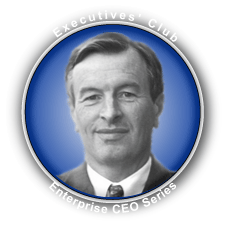 Michael L. Eskew, Chairman and CEO of UPS, outlined the package delivery giant’s vision for transforming itself into a “one-to-one” business at the Executives’ Club of Chicago’s Enterprise CEO Lunch, 15 February 2007. Before a packed house at the Chicago Hilton, he demonstrated UPS’s creative “whiteboard” marketing campaign and explained its role in communicating to customers the value of the company’s transformation. Michael L. Eskew, Chairman and CEO of UPS, outlined the package delivery giant’s vision for transforming itself into a “one-to-one” business at the Executives’ Club of Chicago’s Enterprise CEO Lunch, 15 February 2007. Before a packed house at the Chicago Hilton, he demonstrated UPS’s creative “whiteboard” marketing campaign and explained its role in communicating to customers the value of the company’s transformation.
The importance of UPS’s vision extends beyond UPS stakeholders because it reflects a shift in emphasis away from industrial efficiency to knowledge-based innovation. Make no mistake, efficiency is mission-critical to every business, but fewer companies can differentiate based on efficiency. To its considerable credit, UPS sees the shift and is striving to empower customers with information as well as delivery services.
A History of Transformation
Mr. Eskew set the context by emphasizing that UPS has a history of transforming itself to meet technology and market challenges:
Founder Jim Casey began the company as bicycle messenger service in 1907, but emerging […]
Immensely Valuable Field Guide for Word of Mouth Practitioners—with a Twist
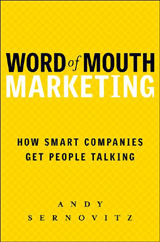 Word of Mouth Marketing is an exceptionally useful, insightful and surprising book. Andy Sernovitz has done a masterful job at creating a brief, lucid and tactical guide to realigning your company’s relationships with your customers, quickly and inexpensively. It is very straightforward, honest and full of practical techniques. Moreover, it is very human because it addresses customers as human beings, not demographics. I suspect that this aspect of the book might peeve those marketers that are invested in the difficulty and complexity of their craft. Think about it: when customers were (relatively) mute and invisible, marketers were the intermediary between the enterprise and the customer; in the absence of the customer’s voice, they created models and theories to simulate it. WOM, powered by Web 2.0, means that customers can talk in their own words, and companies can listen. The customer’s back! Word of Mouth Marketing is an exceptionally useful, insightful and surprising book. Andy Sernovitz has done a masterful job at creating a brief, lucid and tactical guide to realigning your company’s relationships with your customers, quickly and inexpensively. It is very straightforward, honest and full of practical techniques. Moreover, it is very human because it addresses customers as human beings, not demographics. I suspect that this aspect of the book might peeve those marketers that are invested in the difficulty and complexity of their craft. Think about it: when customers were (relatively) mute and invisible, marketers were the intermediary between the enterprise and the customer; in the absence of the customer’s voice, they created models and theories to simulate it. WOM, powered by Web 2.0, means that customers can talk in their own words, and companies can listen. The customer’s back!
However, this direct customer connection also means that marketing will be much more fun and less frustrating for companies that understand the shift and engage their customers. This direct, fun and productive new reality emanates from the book’s […]
Retrofitting GM, the Quintessential Industrial Economy Enterprise reflects Knowledge Economy disruption as production-focused enterprises languish as customers continue to forsake them.
 As readers of these pages know well, I estimate that one of the most poignant changes that faces Industrial Economy enterprises is shifting their primary focus from production and operations to the customer. The Industrial Economy mechanized work and production, and by any measure it created unprecedented wealth by drastically lowering per-unit costs of any kind of product you can name, bringing more products within the means of more people. This worked extremely well while demand exceeded supply: customers were excited to have their first car/house/television, and they were happy with what producers brought to market. As readers of these pages know well, I estimate that one of the most poignant changes that faces Industrial Economy enterprises is shifting their primary focus from production and operations to the customer. The Industrial Economy mechanized work and production, and by any measure it created unprecedented wealth by drastically lowering per-unit costs of any kind of product you can name, bringing more products within the means of more people. This worked extremely well while demand exceeded supply: customers were excited to have their first car/house/television, and they were happy with what producers brought to market.
However, Industrial Economy CSFs (critical success factors) look extremely stale in the Knowledge Economy (also see Transformation: From Self-contained Company to Networked Global Organization). The e-business revolution has vastly enhanced communications, decreased cycle times and moved the mass customization model closer to reality.
Big Dealer to Detroit: Fix How You Make Cars (The Wall Street Journal, 9 February 2007) spells out the problem extremely well:
“One of […]
|
|
