 In 2007, countless corporations talked about building their own Facebook (see Wachovia, for one), while Facebook itself declined the invitation. Microsoft, as usual, careened into the ring from the sidelines with its lackluster Sharepoint offering, which produces less corporate entropy than pureplay Web 2.0 vendors but characteristically is short on features and has a slow development cycle. In 2007, countless corporations talked about building their own Facebook (see Wachovia, for one), while Facebook itself declined the invitation. Microsoft, as usual, careened into the ring from the sidelines with its lackluster Sharepoint offering, which produces less corporate entropy than pureplay Web 2.0 vendors but characteristically is short on features and has a slow development cycle.
Based on the interest I am getting from corporations to help them with strategy for social networks and Web 2.0 and my coverage of Forrester and Digital Hollywood, I predict that enterprise social network vendors will have a good year, but enthusiasts should beware of a couple of traps…
[…]
The beta is official as of this post, and I am now focused on adding content. I expect the beta period will last for about two weeks. Please expect that you may experience minor glitches in how this site looks, feels and acts, but you should find it to be functional, and I hope any mishaps will not inconvenience you too much.
I have added to the “About page ” as well as a bio page.
Please comment on content as well as functionality and blog features.
Thanks for your interest, readership and support.
Finally selected the theme and succeeded in wrestling the php to the ground. Too early to declared complete victory, but definitely can see the end in sight. Then will be able to focus on content!
Got most of the key elements in place, so here we go with the alpha release! Still a couple of nagging mysteries to be solved, but happy with progress.
This should take shape over the next few days, but right now still struggling with the opaque (at least to me) php.
U.S. Economy Due for Sideways Year—Special Effects by Presidential Election—Uncomfortable Long-term Questions Waiting in Wings
 The Executives’ Club of Chicago assembled an all-star panel to give Midwest business leaders their guidance for various aspects of the U.S. economy in 2008. Diane Swonk, Chief Economist of Mesirow Financial and Robert “Bob” Froehlich, Chairman of the Investment Strategy Committee, Deutsche Asset Management returned, and the mystery panelist was Jack Ablin, Chief Investment Officer, Harris Private Bank. They broke out their respective crystal balls for 2008, along with comedic effects. The session was brilliantly moderated by Terry Savage, Financial Columnist of the Chicago Sun-Times who didn’t miss a beat and extracted specific predictions from panelists. The Executives’ Club of Chicago assembled an all-star panel to give Midwest business leaders their guidance for various aspects of the U.S. economy in 2008. Diane Swonk, Chief Economist of Mesirow Financial and Robert “Bob” Froehlich, Chairman of the Investment Strategy Committee, Deutsche Asset Management returned, and the mystery panelist was Jack Ablin, Chief Investment Officer, Harris Private Bank. They broke out their respective crystal balls for 2008, along with comedic effects. The session was brilliantly moderated by Terry Savage, Financial Columnist of the Chicago Sun-Times who didn’t miss a beat and extracted specific predictions from panelists.
Panelists agreed that the U.S. economy would struggle in 2008, but it would move mostly sideways, probably eking out a 1-2% gain for the year after an unsatisfying first half. All panelists predicted that the Dow would touch 14,000 sometime during the year. Froehlich again emphasized the importance of looking beyond the U.S. for investments. Swonk and Ablin were less outspoken but had high non-U.S. allocations in their […]
Year in Review 2007—Editor’s Choice of the Global Human Capital Journal
 As I reflect on 2007 and create strategy for 2008, several macro-trends come into sharp relief, and I believe that some of them might be helpful to you as you conduct your own planning. As always, I focus on emerging phenomena because they are areas in which disruption and discontinuous change are acting on markets, thereby elevating threats and opportunities. Helping leaders to create strategy to manage the risk of unusual market developments is the focus of my consulting practice. As I reflect on 2007 and create strategy for 2008, several macro-trends come into sharp relief, and I believe that some of them might be helpful to you as you conduct your own planning. As always, I focus on emerging phenomena because they are areas in which disruption and discontinuous change are acting on markets, thereby elevating threats and opportunities. Helping leaders to create strategy to manage the risk of unusual market developments is the focus of my consulting practice.
In 2007 it became clear to me that we were entering a profound social transformation that would produce an unimaginable degree of change. Unlike the technology-precipitated change that I’ve been helping people with since the 1990s, technology is shifting to the background now, and pervasive social change is taking the stage. Look for disruption in all areas affected by how people connect, communicate, purchase and collaborate: business, politics, community and leisure. Moreover, these changes are completely global with all the variations that engenders.
I […]
Globalization’s 21st Century Makeover explains how “emerging” market companies are rapidly becoming global players—to whit, new owners for Jaguar and Land Rover.
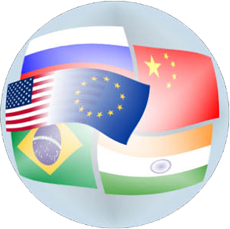 Emerging countries have long been regarded by globalizers as targets for exploitation, but 21st century market forces are turning legacy thinking on its head, which produces disruption and its sibling, opportunity. Emerging countries have long been regarded by globalizers as targets for exploitation, but 21st century market forces are turning legacy thinking on its head, which produces disruption and its sibling, opportunity.
The conventional thinking goes that emerging countries like Brazil, Russia, India and China (BRIC) have talented knowledge/human capital resources that can be tapped in outsourcing and offshoring arrangements. Moreover, these workers’ employment in high value knowledge jobs creates a new consumer class among large populations. Emerging countries’ rapidly growing consumer markets stand in sharp contrast to developed countries’, which are flat or shrinking. China and India have been relaxing restrictions on foreign ownership, which has increased FDI, especially in China, enabling foreign companies to invest in and buy BRIC companies.
However, the big story in 2007 was the opposite:
[…]
Disrupting the Automobile explores how several ventures are changing the rules of an intractable industry.

The automobile is a personal manifestation of the ultimate promise of the Industrial Economy—that physical power is essentially free—because it enables people to move quickly and easily. People just love cars because it is immensely satisfying to glide effortlessly (traffic notwithstanding ,^) from one place to another with a high degree of individual freedom.
However, as 2007 draws to a close, autos’ current reliance on fossil fuels makes it increasingly obvious that we need to change the rules. First, new wealth in emerging markets is dramatically increasing auto ownership and its concomitant demand for oil. Increased demand and uncertain supply will undoubtedly prove unsustainable in the medium term. Second, and even more daunting, is the carbon/climate change problem, which is far more life-changing in the long term. Petroleum and coal are the largest contributors to man-made carbon emissions.
[…]
Edison as Mashup Artist: Combining Discipline, Process and Intuition
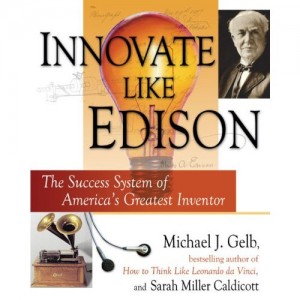 Innovate Like Edison is a must-read for anyone who wants to thrive in the “flat world.” Had it been written in the 20th century, the book would have been applicable to R&D leaders, and it would have been a nice-to-have for business and government leaders. Innovation was the place kicker on the team during the Industrial Economy because companies created value through efficiency (refining continuous processes), and innovation is about discontinuous processes. Innovate Like Edison is a must-read for anyone who wants to thrive in the “flat world.” Had it been written in the 20th century, the book would have been applicable to R&D leaders, and it would have been a nice-to-have for business and government leaders. Innovation was the place kicker on the team during the Industrial Economy because companies created value through efficiency (refining continuous processes), and innovation is about discontinuous processes.
In the 21st century Knowledge Economy, however, innovation is the linebacker. Customers merely expect world-class efficiency, but it rarely differentiates. Innovation is now a core competency at most levels of every organization.
The problem is, the authors explain, is that very few people are innovation literate, and they don’t know how to practice it practically. As I’ve written extensively, business innovation failures are over 95%, and most new products fail at high rates. We must reposition innovation as a linebacker, and that means understanding it differently and treating it differently.
[…]
|
|
