
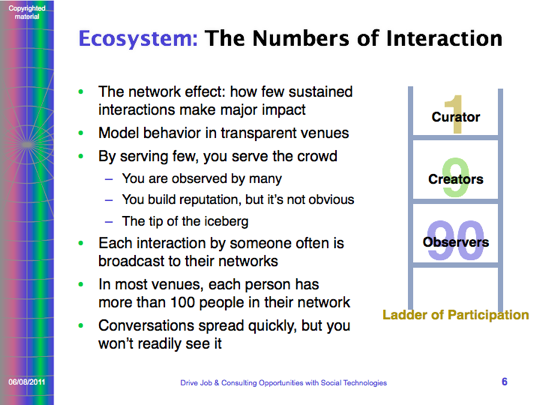
Most of us are familiar with Forrester’s Ladder of Participation, but using it to build engagement and community still escapes most individuals and organizations, so here I’ll offer a short treatment within the context of Facebook [click graphic right to enlarge]. The profound insight is that 90% of people in a social venue observe without interacting. 9% are the creators, they tweet, blog and make themselves known. 1% are curators, they sort and categorize content. Whether you are on LinkedIn, Facebook or authoring a blog, you only hear 10% of the people, but you are affecting 100% of the people. If you don’t know that, you might think your online activities were going unnoticed. Now I’ll turn to how this works in Facebook.
[…]
 In Five Tips for Smarter Social Networking in their Big Shift Harvard Business Review blog, John Hagel III and John Seely Brown offer solid advice for executives who want to get traction with social networks, some of which might surprise you. It’s valuable for executives from individual and company perspectives. Here’s the post, and here’s my response, which builds and extends some of their points:
 2008 was a momentous year punctuated by rising economic uncertainty, Web 2.0 innovation in politics and increasing opportunity to create uncommon advantage in many industries. How much can volatility increase? We are on a merry-go-round that’s accelerating; it’s giddy and scary, depending on one’s point of view.
 Today an executive asked me to explain the value of Twitter versus voice mail for a particular mobility use case: she is at a business gathering and talking to “Jack,” someone whom “Barbara,” a friend of hers would like to meet (Barbara isn’t at the gathering but might be able to come by). Should she voice mail or send Barbara a tweet with the Jack’s information and willingness to connect? Read on to understand some of the nuances and virtues of microblogging (Twitter), SMS (short message service, or “text” messages in U.S. parlance) and voice mail.